
• Skip to main content
  • Skip to secondary menu
  • Skip to primary sidebar
  • Skip to secondary sidebar
  • Skip to footer

  • COVID-19
  • Opinion
  • Health IT
    • Behavioral Health
    • Care Coordination
    • EMR/EHR
    • Interoperability
    • Patient Engagement
    • Population Health Management
    • Revenue Cycle Management
    • Social Determinants of Health
  • Digital Health
    • Artificial Intelligence
    • Blockchain
    • Mobile Health
    • Precision Medicine
    • Telehealth
    • Wearables
  • Startups
  • M&A
  • Value-based Care
    • Accountable Care (ACOs)
    • Medicare Advantage
  • Life Sciences
  • Research

69% of Providers/Payers Are Uncomfortable with Risks of Value-Based Care

by HITC Staff 02/29/2016 Leave a Comment

  • LinkedIn
  • Twitter
  • Facebook
  • Email
  • Print

69% of Providers/Payers Are Uncomfortable with Risks of Value-Based Care

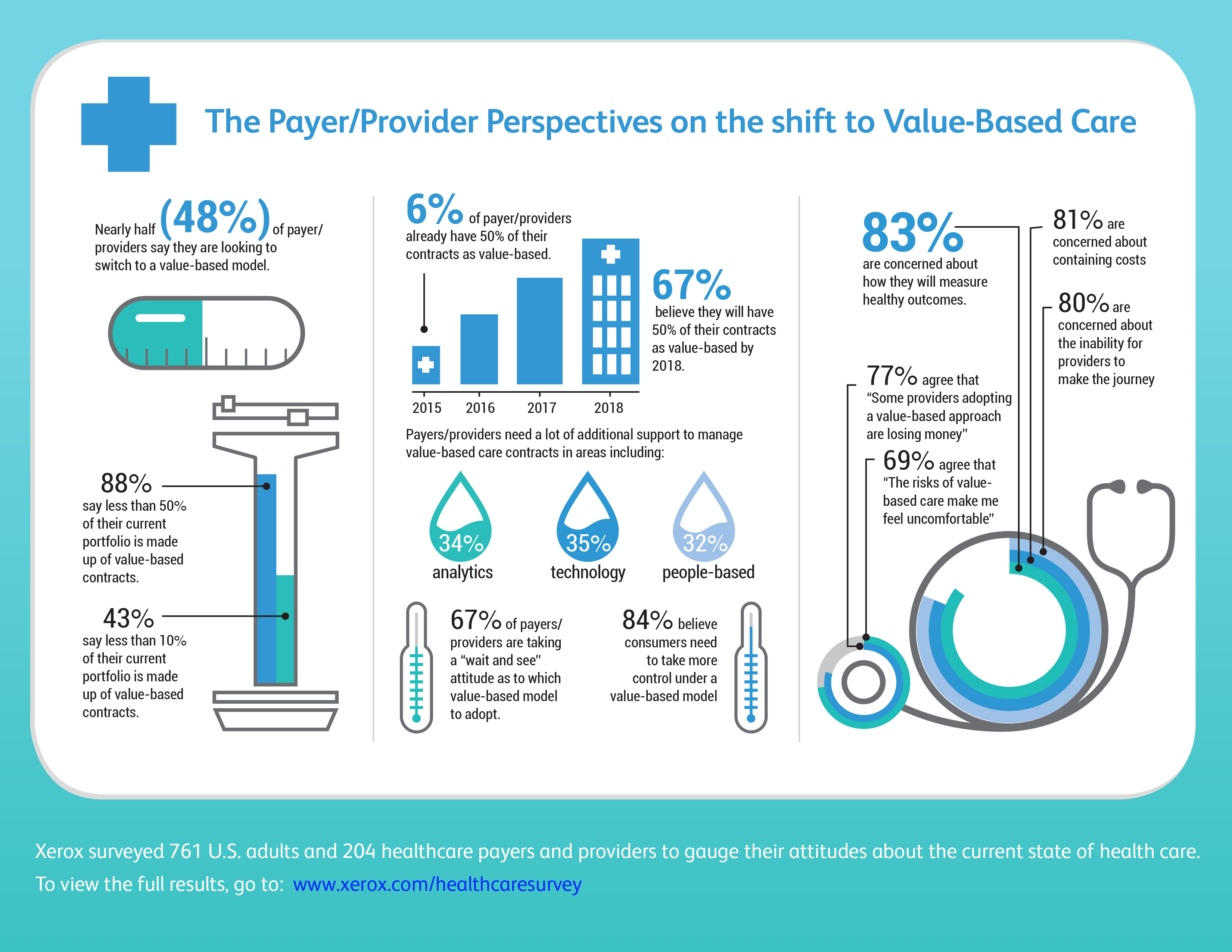
By 2018, the Centers for Medicare & Medicaid Services (CMS) will require 50 percent of payments to be value-based, meaning providers are compensated for healthy outcomes rather than each service provided. According to new research from Xerox, 69 percent of healthcare providers and payers are uncomfortable with the risks of value-based care, and 77 percent agree that some providers are losing money by adopting the approach.

The Xerox survey reveals that healthcare payers and providers have some apprehension about the shift to value-based healthcare. 43 percent of healthcare providers and payers say value-based contracts make up less than 10 percent of their current portfolio, leaving much ground to make up. 

Other key finding of the survey include: 

– Of the commercial reimbursements, 64% are currently 50% or less value-based

– 67% of Payer/Providers have either already switched (19%) or are currently looking to switch (48%) to a value-based model

– By 2018, 67% of respondents believed that at least half their payments/reimbursements would be value-based (though only 6% have already attained this mark).

– Of the Payer/Providers who’ve already implemented value-based care, half indicate they are already seeing the benefits

– A solid majority of our sample agreed that value-based care would provide at least some benefits for all three major parties: payers (86% agree to some extent), patients (82%), and providers (76%)

– When asked about their major concerns with value-based care, Payer/Providers indicated the top three were “how to measure healthy outcomes” (83%), followed by “cost containment” (81%), and “an inability for providers to make the journey/poorly optimized physician networks” (80%).

– Solid majorities of Payer/Providers indicate How much additional support are you needing to manage your value-based care in the following areas? they need of at least some help to handle the challenges of implementing value-based care across the full gamut of analytics, software, service, technology, and people-based services

– To build value-based contracts, Payers/Providers indicate they currently have a range of information needs, particularly with clinical data (64%). 

To view the full results of the survey, visit: www.xerox.com/healthcaresurvey.

 

  • LinkedIn
  • Twitter
  • Facebook
  • Email
  • Print

Tagged With: Value-Based Care

Get in-depth healthcare technology analysis and commentary delivered straight to your email weekly

Reader Interactions

Primary Sidebar

Subscribe to HIT Consultant

Latest insightful articles delivered straight to your inbox weekly.

Submit a Tip or Pitch

Knowledge Hub

 How Top Health Plans Use AI to Save Money and Work Smarter How Top Health Plans Use AI to Save Money and Work Smarter

 How to Build Hybrid Care Models Around Remote Patient Monitoring How to Build Hybrid Care Models Around Remote Patient Monitoring

Trending

Olive Secures $400M At A $4B Valuation to Support New Instant Claim Payment Solution

Olive Shutters Business After Sale to Waystar and Humata Health

Clinician Shortage Worsens Primary Care Crisis, Experts Reveal

Clinician Shortage Worsens Primary Care Crisis, Experts Reveal

FDA Grants Clearance for UltraSight's AI Cardiac Ultrasound

Israel Defense Forces to Utilize UltraSight’s PoCUS Devices in Combat

The Future of Biomarker-Based Therapy for Mental Disorder Care

The Future of Biomarker-Based Therapy for Mental Disorder Care

HLTH23: 6 Digital Health Executives Share Key Takeaways

6 Digital Health Executives Share Key Takeaways from HLTH23

HIMSS Appoints New Chief Financial Officer & General Counsel

HIMSS Appoints New Chief Financial Officer & General Counsel

GoodRx Now Offers Access to $35 Insulin to All Americans

GoodRx Now Offers Access to $35 Insulin to All Americans

Ozempic: From Diabetes Management to Potential Weight Loss Miracle

Ozempic: From Diabetes Management to Potential Weight Loss Miracle

Health M&A: Financial Distress Driving Q3 Healthcare Deals

Health M&A: Financial Distress Driving Q3 Healthcare Deals

GE HealthCare Inks $44M Contract with BARDA to Develop AI-Driven Ultrasound Tech

GE HealthCare Inks $44M Contract with BARDA to Develop AI-Driven Ultrasound Tech

Secondary Sidebar

Footer

Company

  • About Us
  • Advertise with Us
  • Reprints and Permissions
  • 2023 Editorial Calendar
  • Submit An Op-Ed
  • Contact
  • Subscribe

Editorial Coverage

  • Opinion
  • Health IT
    • Care Coordination
    • EMR/EHR
    • Interoperability
    • Population Health Management
    • Revenue Cycle Management
  • Digital Health
    • Artificial Intelligence
    • Blockchain Tech
    • Precision Medicine
    • Telehealth
    • Wearables
  • Startups
  • Value-Based Care
    • Accountable Care
    • Medicare Advantage

Connect

Subscribe to HIT Consultant Media

Latest insightful articles delivered straight to your inbox weekly

Copyright © 2023. HIT Consultant Media. All Rights Reserved. Privacy Policy |