
• Skip to main content
  • Skip to secondary menu
  • Skip to primary sidebar
  • Skip to secondary sidebar
  • Skip to footer

  • COVID-19
  • Opinion
  • Health IT
    • Behavioral Health
    • Care Coordination
    • EMR/EHR
    • Interoperability
    • Patient Engagement
    • Population Health Management
    • Revenue Cycle Management
    • Social Determinants of Health
  • Digital Health
    • Artificial Intelligence
    • Blockchain
    • Mobile Health
    • Precision Medicine
    • Telehealth
    • Wearables
  • Startups
  • M&A
  • Value-based Care
    • Accountable Care (ACOs)
    • Medicare Advantage
  • Life Sciences
  • Research

Report: The State and Science of Value-Based Care

by Fred Pennic 09/16/2022 Leave a Comment

  • LinkedIn
  • Twitter
  • Facebook
  • Email
  • Print

What You Should Know:

– Providers believe 96% of payment is now value-based in some capacity, and 58% believe their EHR vendor won’t be able to support the data strategies required to thrive under value-based care, according to a new study conducted by Morning Consult and Innovaccer.

– The 37-page national research study uncovers key IT infrastructure issues healthcare leaders said are impeding or essential for progress towards accelerating their transformation to value-based care.

The State and Science of Value Based Care

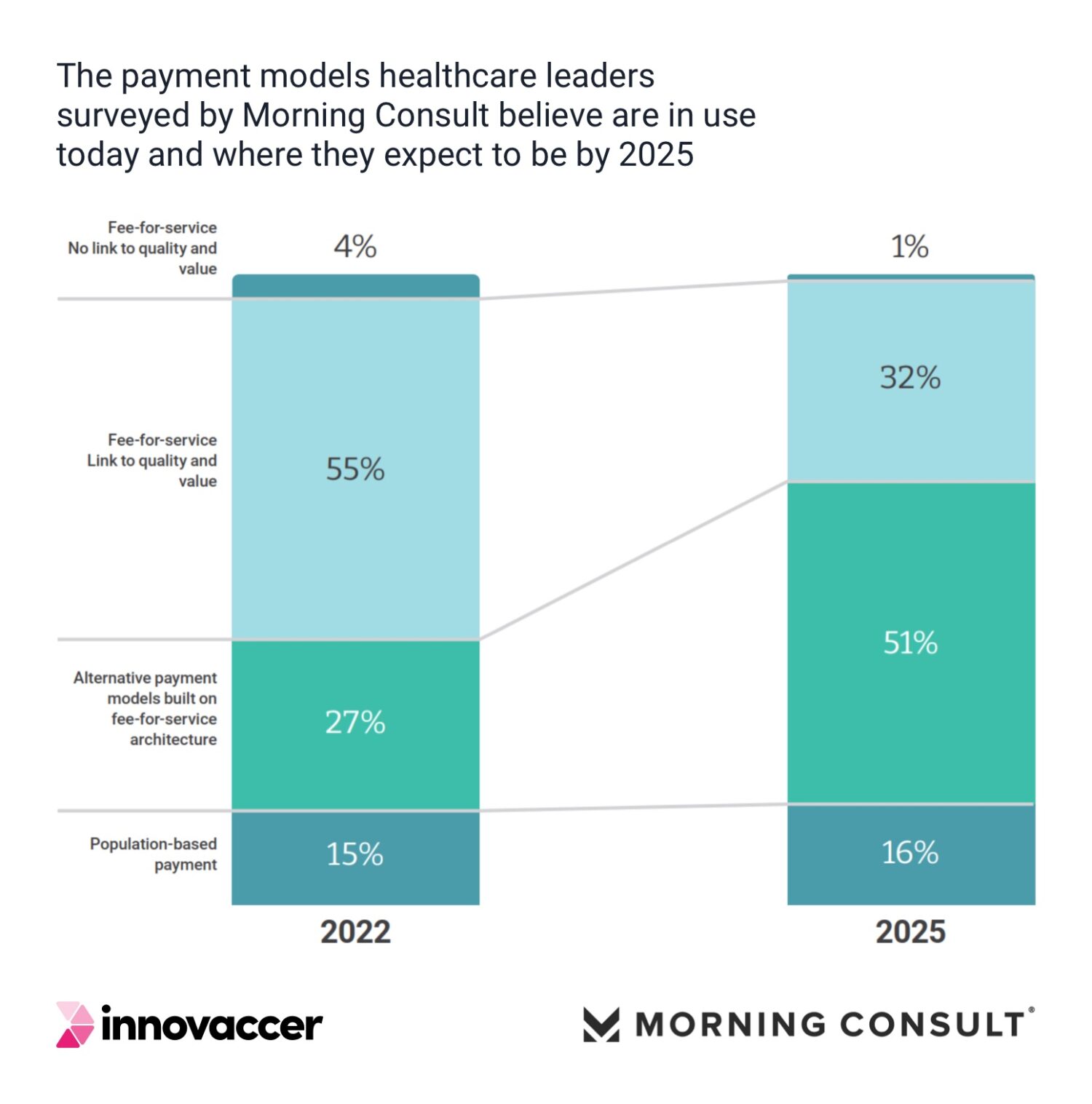
Only 4% of providers today report using pure FFS with no links to quality and value, and that plummets to 1% by 2025. Providers believe the payment model that’s historically dominated in healthcare has flamed out, and that 96% of healthcare payment today has connections to care quality, cost reductions and, in some cases, patient experience. That leaps to 99% by 2025.

Moreover, while providers report they have moved 96% of their revenue into some form of performance risk, 80% of those programs operate on a FFS architecture, where claims submission (as opposed to population-based payment) remains the driving force for value-based analysis and payment. The FFS architecture is even present in Shared Savings models, according to respondents, where healthcare costs are compared with a goal, and providers and payers share in the savings or losses.

– 58% said they didn’t believe their EHR vendor could support their enterprise data strategy.

– 42% said their data is highly fragmented and siloed, a blind spot for insights, workflows, actions, and reporting essential for value-based care delivery.

– 48% said they’re not confident their organization has the infrastructure to capture and use the full range of patient data.

– 41% said their organization needs population health analytics to advance their enterprise data/information strategy, making it the #1 capability sought among ten priorities offered.

– 68% said their organization doesn’t have the AI capabilities to drive digital transformation essential for value-based care.

– 69% of healthcare leaders said they aren’t using technology to identify at-risk patients.

– Despite a 94% increase in the number of executives who expect consumer-generated data to have a high impact on SDoH by 2025, 72% of respondents aren’t integrating medical and social determinants data.

In addition to presenting key findings on providers’ outlook on value-based care, the State and Science of Value-Based Care report covers value-based care challenges and opportunities reported by respondents; addresses the people, process, and technology gaps respondents said must be bridged; and provides expert commentary and guidance to help providers to put their data to work to accelerate their transition to value.

“The research shows a strong relationship between an organization’s investment in modern digital infrastructure and their ability to succeed with value-based payment models,” Stevens said. “Digital investments will be the deciding factor for more mature risk-bearing organizations. The key to value-based care is the ability to integrate data from EHRs and other IT silos—clinical, claims, labs, pharmacy, telehealth, remote monitoring, social determinants, consumer-generated, you name it—into a unified patient record that lets providers drive the analytics-driven workflows, care management, risk stratification, and patient engagement strategies to drive better outcomes at a lower cost.”

For more information, download the State and Science of Value-Based Care

  • LinkedIn
  • Twitter
  • Facebook
  • Email
  • Print

Tagged With: AI, care management, digital transformation, Healthcare Leaders, Innovaccer, model, patient engagement, Patient Experience, Payers, Pharmacy, Population Health, Population Health Analytics, risk, risk stratification, Shared Savings, Value-Based Care, Value-Based Payment Models

Get in-depth healthcare technology analysis and commentary delivered straight to your email weekly

Reader Interactions

Primary Sidebar

Subscribe to HIT Consultant

Latest insightful articles delivered straight to your inbox weekly.

Submit a Tip or Pitch

Knowledge Hub

 How Top Health Plans Use AI to Save Money and Work Smarter How Top Health Plans Use AI to Save Money and Work Smarter

 How to Build Hybrid Care Models Around Remote Patient Monitoring How to Build Hybrid Care Models Around Remote Patient Monitoring

Trending

Olive Secures $400M At A $4B Valuation to Support New Instant Claim Payment Solution

Olive Shutters Business After Sale to Waystar and Humata Health

Clinician Shortage Worsens Primary Care Crisis, Experts Reveal

Clinician Shortage Worsens Primary Care Crisis, Experts Reveal

FDA Grants Clearance for UltraSight's AI Cardiac Ultrasound

Israel Defense Forces to Utilize UltraSight’s PoCUS Devices in Combat

The Future of Biomarker-Based Therapy for Mental Disorder Care

The Future of Biomarker-Based Therapy for Mental Disorder Care

HLTH23: 6 Digital Health Executives Share Key Takeaways

6 Digital Health Executives Share Key Takeaways from HLTH23

HIMSS Appoints New Chief Financial Officer & General Counsel

HIMSS Appoints New Chief Financial Officer & General Counsel

GoodRx Now Offers Access to $35 Insulin to All Americans

GoodRx Now Offers Access to $35 Insulin to All Americans

Ozempic: From Diabetes Management to Potential Weight Loss Miracle

Ozempic: From Diabetes Management to Potential Weight Loss Miracle

Health M&A: Financial Distress Driving Q3 Healthcare Deals

Health M&A: Financial Distress Driving Q3 Healthcare Deals

GE HealthCare Inks $44M Contract with BARDA to Develop AI-Driven Ultrasound Tech

GE HealthCare Inks $44M Contract with BARDA to Develop AI-Driven Ultrasound Tech

Secondary Sidebar

Footer

Company

  • About Us
  • Advertise with Us
  • Reprints and Permissions
  • 2023 Editorial Calendar
  • Submit An Op-Ed
  • Contact
  • Subscribe

Editorial Coverage

  • Opinion
  • Health IT
    • Care Coordination
    • EMR/EHR
    • Interoperability
    • Population Health Management
    • Revenue Cycle Management
  • Digital Health
    • Artificial Intelligence
    • Blockchain Tech
    • Precision Medicine
    • Telehealth
    • Wearables
  • Startups
  • Value-Based Care
    • Accountable Care
    • Medicare Advantage

Connect

Subscribe to HIT Consultant Media

Latest insightful articles delivered straight to your inbox weekly

Copyright © 2023. HIT Consultant Media. All Rights Reserved. Privacy Policy |